


PEI’s rental market is looser than it was, but it is still a landlord’s market. CMHC’s October 2025 survey of purpose-built rentals put provincial vacancy at 2.0%, average rent at $1,261 and the universe at 9,577 units. With a 2% annual rent guideline for 2026 and a legal duty to keep every unit in repair, margins now depend on how efficiently you run maintenance, not on rent growth. That is where a text-based coordination layer such as GoLando fits: tenants report by SMS, and the AI handles triage, vendor dispatch and follow-up while your team keeps its existing software and workflow.
TL;DR
- CMHC’s October 2025 survey reports 2.0% vacancy across PEI, up from the 0.8% recorded a year earlier and now within the province’s 2% to 4% healthy range.
- The 2026 allowable rent increase is 2.0%, with a 3% legal ceiling, so cost control matters more than rent growth.
- Landlords must keep units in repair and post an emergency repair contact, which makes after-hours response a compliance matter.
- Maintenance software for PEI portfolios should take requests by text, screen emergencies, dispatch vendors and report costs without replacing your property management system.
Where the PEI rental market stands
The headline figure is vacancy. CMHC’s October 2025 provincial summary reports 2.0%, with an average rent of $1,261 and a median of $1,100. CMHC rates the vacancy estimate as very good and the average-rent estimate as excellent. These numbers come from the annual Rental Market Survey, which CMHC runs each October and publishes afterwards, so the next release will replace them. Check the live CMHC table before you set a budget.
The direction matters as much as the level. The province’s 2026 to 2028 CMHC action plan notes that vacancy had fallen to 0.8% in the December 2024 survey after post-pandemic population growth, and that median two-bedroom rent had risen 19% over the previous six years. PEI Housing Corporation’s 2025 to 2026 annual report describes apartment vacancy rising from 0.8% in 2024 to 2.1% in 2025, against a provincial target of 2% to 4%.
Two measures of the same survey give slightly different numbers (2.0% and 2.1%) because they cover different sets of units. For planning, treat the market as sitting at roughly 2% in October 2025.
Rents and vacancy by city
Charlottetown, Summerside and Stratford behave differently. The Record’s PEI housing study, using October 2025 data, reports these two-bedroom figures:
| Centre | Two-bedroom rent | Two-bedroom vacancy |
|---|---|---|
| Charlottetown | $1,300 | 1.9% |
| Summerside | $1,263 | 4.9% |
| Stratford | $1,089 | 3.1% |
Source: The Record, PEI Housing Study, October 2025 rental data. The same study puts the average two-bedroom rent across PEI centres of 10,000 or more at $1,293, up from $1,181 a year earlier.
For apartments overall, PNI Atlantic News reported from CMHC data that October 2025 vacancy was 1.6% in Charlottetown and 4.5% in Summerside, with the Summerside estimate of lower quality. Small-sample cells in CMHC tables swing a lot from year to year, so read city figures as a range, not a point.
Supply is arriving
The loosening has a cause. PEI Housing Corporation reports nearly 1,800 housing starts in each of 2024 and 2025, the highest since the 1970s, although the 2,000-start annual target was not met in 2025 to 2026. More new buildings mean more competition for tenants, and newer buildings set the standard for how quickly a repair gets handled.
If you also operate in other Atlantic provinces, our reads on the New Brunswick rental market and the Newfoundland and Labrador rental market show how PEI compares.
What PEI’s rules mean for revenue and repairs
Rent growth is capped
PEI’s Director of Residential Tenancy set the 2026 allowable annual rent increase at 2.0%. The decision allows an increase only once every 12 months, with three months’ written notice on an approved form. The Rental Office’s table lists the guideline as 3.0% in 2024, 2.3% in 2025 and 2.0% in 2026. The Residential Tenancy Act caps it at 3%, and a landlord seeking more must apply to the Rental Office, where an approved extra increase also cannot exceed 3%.
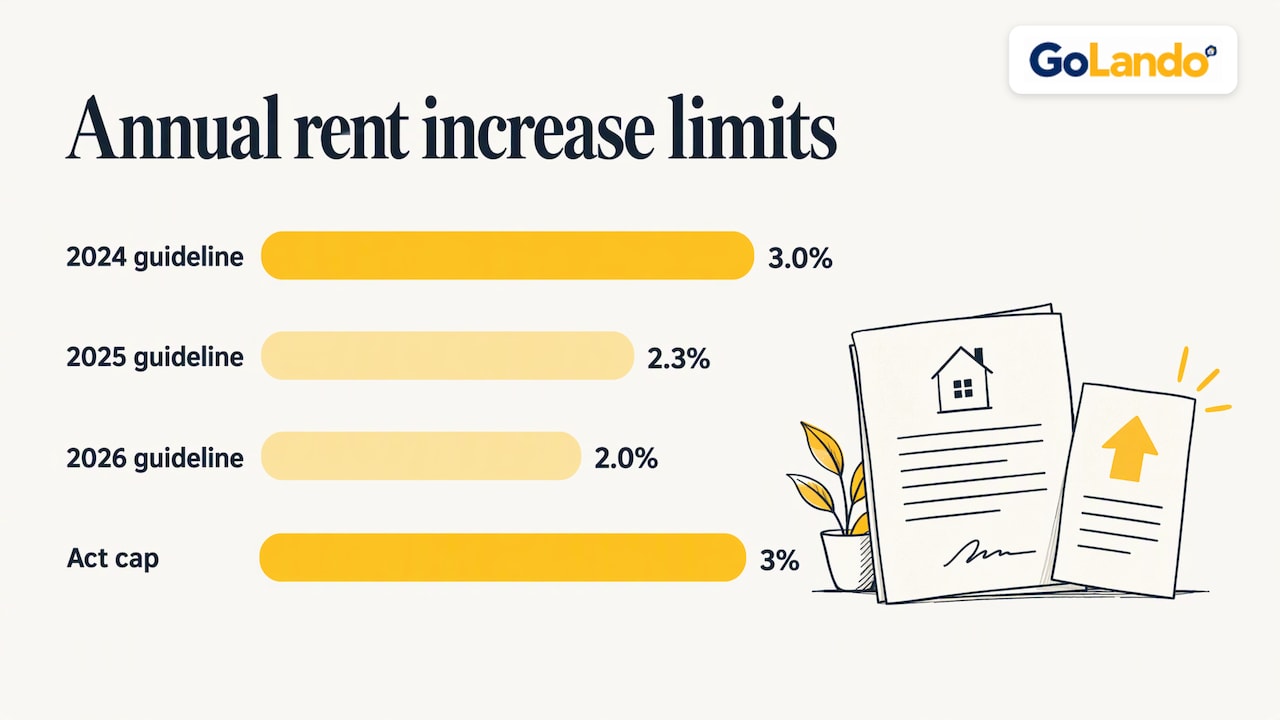
Rent control attaches to the unit, not the tenant, so a new tenant does not reset the rent automatically. On a $1,261 average rent, a 2% increase is about $25 a month per unit. A single avoidable service call can erase several months of that. Operating cost is the lever left to you.
Repairs are a legal duty, not a courtesy
The Residential Tenancy Act requires landlords to provide and maintain the property in a state of repair that meets health, safety and housing standards and is suitable for occupation. Section 29 adds three obligations that shape your operations:
- You must provide and post the name and contact details of a person tenants can call for emergency repairs, covering leaks, blocked plumbing, heating, electrical problems, locks and stairs.
- A tenant may arrange an emergency repair only after reasonable attempts to notify you.
- If they do, you must reimburse them within 7 days of a written claim with receipts.
The Community Legal Information guide for landlords adds that the Public Health Act’s Rental Accommodation Regulations set minimum standards for space, ventilation, heating, lighting and water, including 50 square feet per occupant for sleeping areas and 80 for living areas. Electrical faults are on the statutory emergency list, so it pays to plan electrical upkeep ahead of time; this guide to planning electrical maintenance for rental homes covers the inspection side.
The practical point: a 2 a.m. heating failure in February is a reachability test. If the emergency contact does not answer and the tenant pays a contractor, you owe the money within a week and you may have a documentation gap. For more on handling requests, see our guide to tenant repair requests in Canada.
Why maintenance is the operating lever in a 2% market
When vacancy was 0.8%, a unit relet itself. At around 2%, tenant experience starts to affect renewals and turnover, and with rent increases limited, every other line of cost gets scrutiny. Maintenance has three recurring costs for a PEI operator:
- Staff time on intake. Calls, voicemails and emails arrive in no fixed format and at all hours. Someone has to read them, ask follow-up questions and decide what is urgent.
- Unnecessary dispatches. A tripped breaker, a reset thermostat or a clogged aerator does not need a contractor, but without a first-line check it gets one.
- Follow-up. Confirming arrival, chasing completion and recording cost is slow when it lives in separate inboxes.
These costs scale with unit count. A team managing 300 units across Charlottetown, Summerside and rural PEI feels them every week, and the usual answer, adding a coordinator, raises headcount in step with the portfolio. Our overview of property management trends in Canada looks at where operators are putting automation.
What to look for in maintenance software for PEI rentals
Whether you manage 40 units or 4,000, judge a tool on how much of the coordination it actually does, not how well it records it. A practical checklist:
- Tenant intake with no friction. Tenants in older buildings and seasonal rural rentals will not reliably install an app or remember a portal login. Text works on every phone.
- Triage before dispatch. The system should ask questions, walk the tenant through basic troubleshooting and identify emergencies such as no heat or active leaks, which match the categories in section 29.
- Vendor coordination. It should dispatch to your own trades or an approved network, schedule the visit and follow up until the job closes.
- A record you can use. Request history by property, vendor activity and expenses in one dashboard turn maintenance from a cost centre into something you can measure.
- Fit with your current system. The tool should sit beside your property management software. GoLando integrates with Buildium and is built to complement existing platforms, not replace them.
- Local ownership and market focus. GoLando is Canadian-owned and operated, with Canada as its launch market.
How text-based coordination works in practice
A tenant texts GoLando about a problem. The AI asks what is happening, works through troubleshooting where it makes sense, and flags an emergency if the description matches one. If a professional is needed, it coordinates with an approved service provider, handles scheduling and follows up through to completion. Managers see the request, the vendor and the cost on a central dashboard.
Take a mid-sized PEI example. A tenant in a Summerside fourplex reports no hot water on a Sunday evening. Instead of a voicemail waiting until Monday, the tenant gets an immediate text conversation, the system checks the basics, and if it is a genuine failure it routes the job to your approved plumber or a network vendor. You see the result on the dashboard. The after-hours call that would have interrupted your on-call person never has to reach them for routine cases.
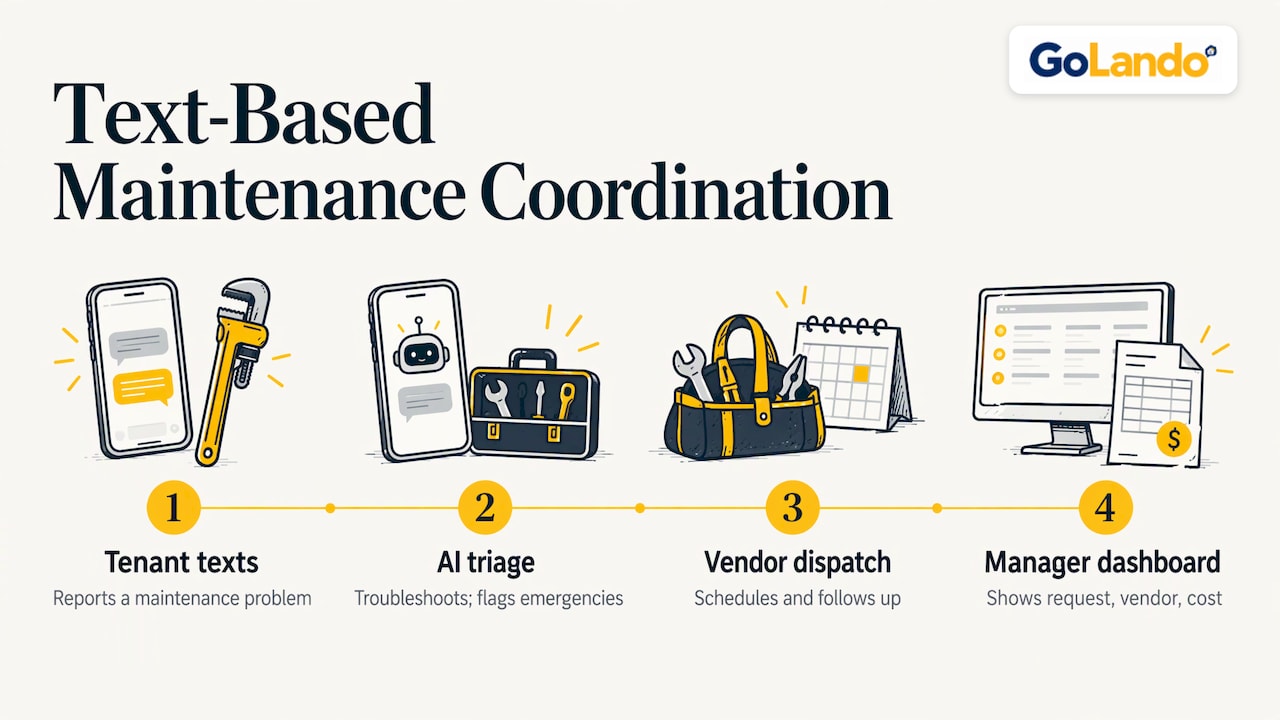
For the mechanics, see how GoLando handles tenant maintenance requests by text, the automated vendor dispatch and the maintenance automation built for property managers.
Our perspective
The PEI market has swung from near-zero vacancy to something close to balance in about a year. Rent growth is capped, and the law says a landlord must be reachable for emergencies. Under those conditions the only part of the P&L you control is how maintenance gets done.
Most property software tracks maintenance requests. It gives you a place to see them, but someone still has to read each one, call each vendor and chase each completion. We built GoLando to automate that work, so the conversation with the tenant, the troubleshooting, the dispatch and the follow-up happen by text without a person in every step.
We do not want to replace your property management system. You keep your workflows, and we take over one of the most time-consuming parts of them. For teams growing their portfolios, the goal is to manage more units without hiring in proportion.
Ryan
GoLando plans for PEI portfolios
GoLando is a subscription tiered by portfolio size. Published monthly prices on the pricing page are $39 for Starter, $69 for Pro, $149 for Pro+, $249 for Mogul and $449 for Scale, with annual billing at $390, $690, $1,490, $2,490 and $4,490 respectively. Enterprise starts from $999 per month for large portfolios. All prices are in Canadian dollars. Tenants and vendors never pay to use it. If you use jobs from the GoLando Vendor Network, a network fee of 5% to 10% applies to those jobs, as described on the vendor page.

If you manage rentals across PEI and want maintenance requests handled by text, see the AI maintenance coordinator for rental properties.
FAQ
What is the vacancy rate in Prince Edward Island?
CMHC’s October 2025 survey reported 2.0% for purpose-built rentals province-wide, with Charlottetown and Summerside showing different readings in different tables. CMHC publishes a new figure each year after its October survey, so check its live table for the latest. For comparison, our post on the Halifax rental vacancy rate covers the neighbouring province.
How much can I raise rent in PEI?
The 2026 allowable increase is 2.0%, once every 12 months with three months’ written notice on the approved form. The Act caps the guideline at 3%, and a larger increase requires an application to the PEI Rental Office. The Director sets the guideline each year, so confirm the figure for the year you are raising.
Do PEI landlords need an emergency repair contact?
Yes. Section 29 of the Residential Tenancy Act requires you to provide and post the name and contact details of a person tenants can call for emergency repairs. If a tenant arranges an urgent repair after reasonable attempts to reach you, you must reimburse them within 7 days of a written claim with receipts. Talk to a lawyer or the Rental Office for a specific dispute.
Does maintenance software replace my property management system?
No. GoLando is designed to complement your existing platform, and it integrates with Buildium. It takes over tenant communication, troubleshooting, vendor dispatch and follow-up, so your team keeps the workflows it already uses.
Sources
- PEI 2026 to 2028 CMHC Action Plan
- PEI Housing Corporation Annual Report 2025 to 2026
- The Record: Prince Edward Island Housing Study
- PNI Atlantic News: PEI rental vacancy rate eases in 2025
- 2026 Allowable Annual Rent Increase decision
- PEI Rental Office: Allowable Rent Increases
- PEI Rental Office: Rent Increases
- PEI Residential Tenancy Act
- Renting on PEI: A Guide for Landlords


